Back to news & insights
Bullets through my bedroom window, and what Pakistan taught me about storytelling
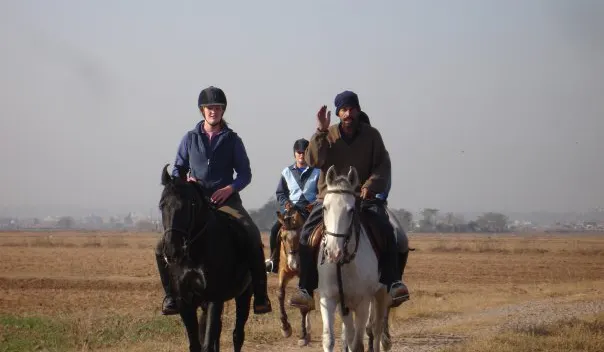
Riding an Indian bred (Marwari) horse with tell tail trait of touching ears near Islamabad.
Twice while I was growing up, the house we lived in in Islamabad was hit. First by a bullet which came through my bedroom window. Later, the as unrest over ‘blasphemous cartoons’ erupted and the blast wave from and attack in the Danish Embassy blew one of the windows in. The house came with my father's posting as defence adviser at the British High Commission, and not long after the Danish embassy attack my parents were moved to a different location to get away from the Norwegian embassy (as the cartoons had also been published in Norway). Unfortunately, that house was closer to the Marriot Hotel which soon suffered a much larger truck bombing. This blew in the heavy front door and damaged many windows. This was the backdrop to my late teens and early twenties: home was a city where the news I watched on television was happening at the end of the street.
I could have kept my distance, stayed in the UK during university holidays. Plenty of people would have. Instead, between the ages of 17 and 21, with the curiosity, and frankly, the blissful naivety of someone that age, I wanted to experience it. I wanted to understand the context, not just survive it.
That choice set the direction of my whole career, and it taught me the thing this whole piece is about: that storytelling is not a nice-to-have. It is the mechanism that decides whether complex science and technology is understood, trusted and adopted, or quietly ignored. Here is how a posting on the edge of a conflict, a maths degree and a centuries-old tribal code taught me why.
The unlikely combination
I was studying maths and statistics, but I had a pull towards human behaviour and culture that was every bit as strong as the pull towards numbers. A mathematician’s head and an anthropologist's curiosity do not usually share a brain.
But, after some tough work convincing my tutors, I built my own way to feed both. I added cultural and regional modules on top of my core degree. In Pakistan, I didn’t want to be there simply as a visiting officer’s daughter, so I secured a job as a research assistant at Bahria University. I wanted a reason to be there that I had earned, and a way into the culture on my own terms.
A code that lives in stories
I spent time trying to understand the Pashtun culture of the tribal areas, the real version rather than the flattened one in the headlines. I rode out with locals, including the famously hospitable Prince Malik Ata, a man I bonded with over horses long before I understood the politics around me. I was wide-eyed and out of my depth, and it remains one of the most mind-opening experiences of my life.
But, I’ve since realised, that what I found became a lens I have used ever since.
Pashtun life is governed by an unwritten code called Pashtunwali. Two of its central tenets are melmastia, hospitality, and nanawatai, the duty to shelter and protect anyone who seeks refuge, even at the cost of your own life. A guest, whether friend, stranger or enemy, must be fed, sheltered and protected once they cross the threshold. This is not politeness. It is sacred obligation, and it carries real strategic weight: analysts have long noted that these same principles were exploited to give insurgents shelter in rural Pashtun areas, helping them hold out against far better resourced forces.
It baffled me how this belief could have remained so strong and governed millions of lives for centuries. Yet it was never written down. It lives in poetry, in proverbs, in the councils where elders settle disputes, in stories told and retold. The knowledge that decided who was protected and who was not survived because it lived in narrative.
Why our brains run on stories
That was the moment an academic idea became real for me.
Human beings do not pass on what matters most through facts and figures (‘what!’ says the math’s side of my brain!). We do it through story. Our brains are built for it.
A story gives a fact somewhere to live, makes it memorable, and quietly turns the listener into someone who carries it forward and acts on it. In the tribal areas this was not a soft observation. It was, quite literally, a matter of life and death whose story you believed.
And that same machinery is running in every boardroom, every conference hall and every investor meeting you will ever walk into. We just notice it less, because the risks feel lower.
But are they?
Why this matters for innovation in defence and security
Hold that next to the innovation challenge we face.
We are asking brilliant people to communicate science and technology so complex that even the people building it struggle to explain it. And the capability only matters if others understand it. If the decision-maker grasps it. If the investor sees the value. If the user trusts the output.
This is where innovation so often stalls. Not because the technology is weak, but because the story is missing. A breakthrough that cannot be understood cannot be funded, adopted or trusted, however good it is, and the slower, better-explained option wins. Storytelling is not decoration laid over the complexity. It is the mechanism that moves an idea off the lab bench and onto the front line.
The Pashtun did not rely on story because it was charming. They relied on it because it was the most powerful method available for making knowledge stick and spread. It still is. Most of us in this sector are simply never taught to use it.
Where you start: Technical Storytelling
Everything I have just described, the science of why story makes knowledge stick and the craft of building one that carries complex technology, is exactly what our Technical Storytelling Lab is designed to teach. It is the most practical place to start, because it goes straight to the heart of the problem we keep tripping over: brilliant work that nobody outside the room can understand.
You will be in a small group, taught by people who have lived in both the technical and the human worlds and shaped by years of research into how innovation really motors when you get the storytelling right.
Take note. The quality of your idea and the quality of the story you tell about it are not the same thing. The second one decides the fate of the first. That is a lesson I will forever seek new ways to perfect – let me shortcut this process for you and share what I’ve learn to date.
Come and join us for the next session.
https://www.tickettailor.com/events/cannycomms
More news & insights
Commanding under fire, caught in the spotlight - every woman in defence needs to read this
Last updated: May 2026
You're not selling a product; you're managing someone else's risk.
Last updated: May 2026
The UK's innovation pipeline is failing. Here is what we can do about it.
Last updated: April 2026